<?xml version="1.0" encoding="utf-8"?><feed xmlns="http://www.w3.org/2005/Atom" ><generator uri="https://jekyllrb.com/" version="4.2.2">Jekyll</generator><link href="http://0.0.0.0:4000/feed.xml" rel="self" type="application/atom+xml" /><link href="http://0.0.0.0:4000/" rel="alternate" type="text/html" /><updated>2026-03-11T19:13:37+00:00</updated><id>http://0.0.0.0:4000/feed.xml</id><title type="html">Isle of Avalon Amateur Radio Club</title><subtitle>This is the website of the Isle of Avalon Amateur Radio Club, based in Glastonbury, South West England.</subtitle><author><name>IoAARC</name></author><entry><title type="html">The 31 Set: a survivor remembers</title><link href="http://0.0.0.0:4000/2026/03-11-the-31-set.html" rel="alternate" type="text/html" title="The 31 Set: a survivor remembers" /><published>2026-03-11T00:00:00+00:00</published><updated>2026-03-11T00:00:00+00:00</updated><id>http://0.0.0.0:4000/2026/the-31-set</id><content type="html" xml:base="http://0.0.0.0:4000/2026/03-11-the-31-set.html"><![CDATA[<blockquote>
  <p>“You must have had a fun childhood.”</p>

  <p><a href="https://en.wikipedia.org/wiki/The_Terminator">Sarah Connor</a></p>
</blockquote>

<figure>
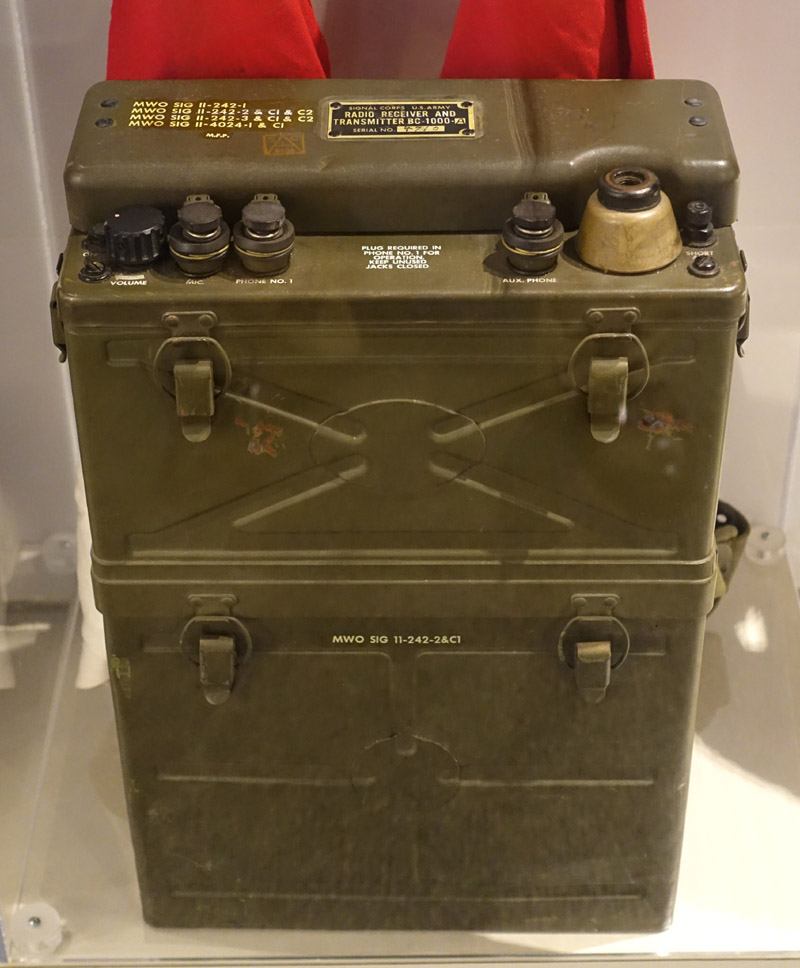
<img src="/assets/2026/SCR-300.jpg" alt="An American SCR-300" />
  <figcaption>The original SCR-300 with its special connectors</figcaption>
</figure>

<p>At the age of thirteen I was drafted.</p>

<p>Having for some time been an inmate in that sort of minor English public school which sees its purpose as feeding Sandhurst and in which the names of the dead go all along the wall of the Chapel and all around the Garden of Remembrance (and not every school even has one of those), and not having the sort of parents who would insist upon, and if necessary pay extra for, some soft option like the so-called ‘Social Service’ (who went around mending things) or the ‘Pioneers’ (who went around breaking them again), or even the Naval Section (about which others must reminisce, the veil of decency having been drawn), I was when the time came duly drafted into the Army section of the CCF.</p>

<p>Paris having only recently very nearly fallen to the <a href="https://en.wikipedia.org/wiki/Paris_1968">Situationists</a> someone clearly thought we’d be needed for something real before long and so we did very little of the chocolate soldiering so common in more effete cadet forces (e.g. we once visited another school where all they ever did was incredibly complex marching and counter-marching in a rather showy American manner accompanied by a vast and well equipped band, all this being done in mediaeval ecclesiastical costume) but instead went to cool places and got trained in cool stuff by the likes of the Ghurkas and the SAS.</p>

<p>Alas this idyllic state could persist only so long and having completed what they called basic training I then had in theory to choose a specialisation. However the Major in command of the whole circus (who looked, as he was so often reminded, like <a href="https://en.wikipedia.org/wiki/Klaus_Fuchs">Klaus Fuchs</a> and who in his spare time taught geography) somehow found out that my father when at the same school some decades previously had distinguished himself by (probably meaning ‘was beaten for’) having made a television receiving set from a war surplus radar tube and some other stuff, and without further ado put me into Signals.</p>

<p>The signals section occupied the top floor of a ratty old town house (the middle floor was a photographic darkroom and the ground floor a secondhand school uniform shop) on the other side of the road opposite the school’s ancient Old Hall and the lych-gate. The Major, loving every minute of this, elected to treat it as though it were secret and so apart from wire antennas strung from the top of the house to all kinds of unlikely things and the occasional vertical appearing and disappearing one would not have known that it was there.</p>

<p>Inside was like a very low budget but highly technical gentlemen’s club. Refined and sophisticated people sat around in threadbare armchairs or on bar stools drinking tea and eating biscuits and other forms of tuck while dismantling, reassembling, connecting, disconnecting and generally trying to operate any number of <a href="https://en.wikipedia.org/wiki/Wireless_Set_No._19">19 Sets</a> in the cosy warm fug commonly created by any sizable conspiracy of thermionic valves and soldering irons.</p>

<p>This bourgeois clique, tantamount to an owners’ club, had persuaded the Major that with only another few years of complete peace and quiet they might given certain other technical circumstances be able to connect his private army with the rest of the British one by radio, and had also suggested to anyone less official that with this same provision they might instead be able to arrange the general and inevitable reception of the then fashionable offshore pirate radio stations whose not inconsiderable repertoire consisted of those pop singles which had been banned by the BBC.</p>

<p>Alas owing to my being only a Buck Assed Private (we habitually used Vietnam terminology out of sympathy for our unlucky American cousins) none of this <a href="https://en.wikipedia.org/wiki/Glide_Path">Clarkist</a> stuff was for me.</p>

<p>Instead those younger and less strategic fellows thought to need exercise to bring them up to the physical fitness standards of the unit were formed into a tactical communications group, issued with 31 Sets and told to get on with it.</p>

<figure>
<img src="/assets/2026/97906.jpg" alt="A museum example of a 31 Set" />
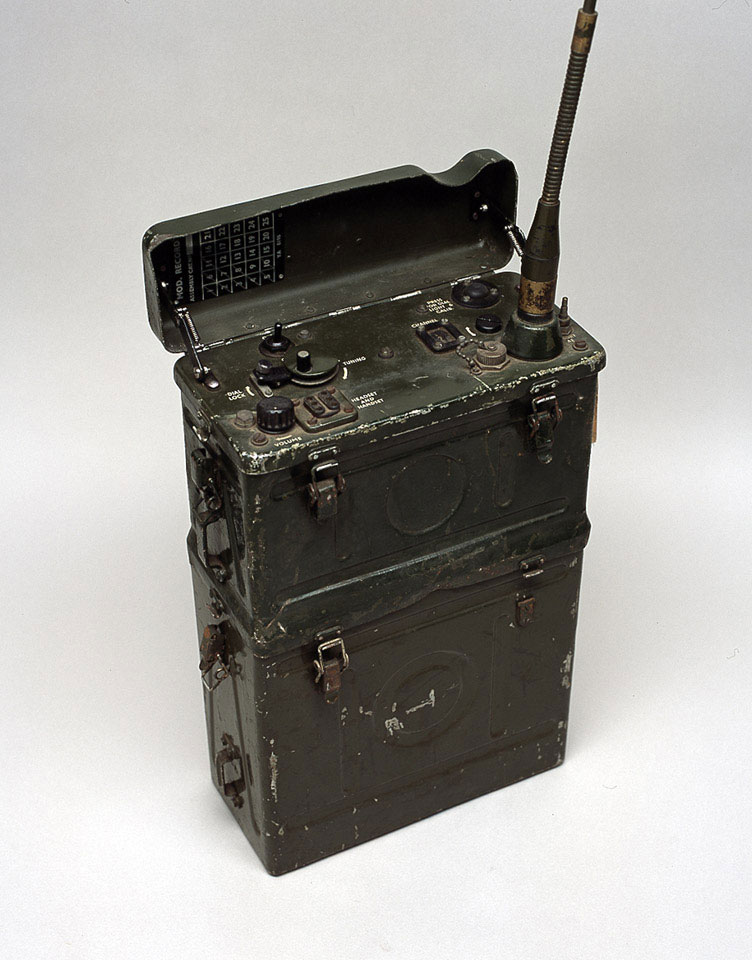
  <figcaption>A museum example of a 31 Set</figcaption>
</figure>

<p><a href="https://collection.nam.ac.uk/detail.php?acc=2002-11-733-1">Wireless Set 31</a> is the British issued version of the Galvin (later Motorola) SCR-300. It is a man portable tactical low VHF FM voice set, its specifications <a href="https://en.wikipedia.org/wiki/SCR-300#Specifications">here</a>. It has only 0.3W RF output; this is because tactical radios need to work over just so much distance and no more, lest others overhear. The quoted range is 3 miles, dependent upon terrain and antenna.</p>

<p>This equipment was the first ever to be called a ‘walkie-talkie’, and featured in D-Day. There was also a <a href="http://shortwaveradio.ch/doku.php?id=en:wireless_set_no.31">vehicle mobile variant</a>; this variant appears to have survived better than the infantry type and is more commonly found in collections.</p>

<p>Wikipedia says:</p>

<p><em>Colonel Ankenbrandt informed General Meade that “they are exactly what is needed for front line communications in this theater”. In his point of view, the main difficulty was keeping them supplied with fresh batteries.</em></p>

<p>Alas by this hangs, heavily,  a tale. The set could be powered by either of the BA-70 or BA-80 battery packs. These were specially made by a subcontractor and were dry battery packs of different capacities configured to deliver the three voltages (4.5, 90, 150) required by the set and provided with the connector to match it. Either battery pack could be attached underneath the set to make a reasonably man portable if rather heavy small-rucksack sized item. The heavier BA-70 together with the set weighed nearly forty pounds (17.34kg).</p>

<p>Unfortunately as Colonel Ankenbrandt discovered these battery packs were difficult to obtain even during WWII as the subcontractor became progressively less able to supply them. Since WWII they have of course been completely unobtainable even by museums, who habitually exhibit empty battery casings.</p>

<p>Accordingly and with a sort of Royal Engineers attitude a technical fix was duly put in.</p>

<p>31 Set empty battery casings being available a sufficiency had been obtained to provide each set with two battery casings instead of one. If memory serves me right they were of slightly different heights so perhaps one was a BA-70 type and the other a BA-80. The combination of rig and two battery boxes stood the best part of three feet high.</p>

<p>This Magnum was permanently fastened to a ladder frame aluminium artefact called ‘<a href="https://montgomerymilitaria.com/shop.php?code=50215">Carrier Manpack Type 3</a>’ (type 1 illustrated as no other photo found; type 3 I remember to be somewhat longer and narrower but stylistically very similar) and the two battery boxes were filled with dozens and dozens of tiny glass jar type 2V wet-cell accumulators, allegedly once intended to be used in threes to provide 6V for motor scooter electrics somewhere in Europe.</p>

<p>These accumulators were considerably smaller than <a href="https://www.museumoftechnology.org.uk/objects/_expand.php?key=191">the kind commonly used hitherto for domestic radio receivers</a>, were rectangular rather than square in plan, lacked handles and had their two terminals and stopper in a straight line. There appears to be no photo of such things available. In theory there should have been 75 of these cells to each radio for 150V plate voltage but I never actually counted them. Nor did I ever weigh anything but making reasonable assumptions one might guess that the whole apparatus, radio, boxes, accumulators and carrier, could have weighed as much as thirty kilos, like a large and full <a href="https://www.arrse.co.uk/wiki/Bergen">bergen</a>.</p>

<p>One was expected to carry this impressive item vertically and carefully so that none of the accumulators would spill (the stoppers were not perfectly reliable). This idea was of course somewhat incompatible with that of hurling oneself to the ground when fired upon.</p>

<p>There was a sort of yoga movement in which one would pick up the manpack from its position standing vertically on its bottom and carry it off, to deposit it later by a sort of reversal of this procedure, only I always found it much more difficult to put the thing down than to pick it up; perhaps that is why rather more than half a century later I have such a fine collection of hernias.</p>

<p>Having picked it up one was then expected to carry the thing to the exercise area, mostly woodland the property of a distant stately home and some two miles and three hundred or so feet of ascent away, to provide communications for some tactical purpose connected with an exercise. The Major made up all these exercises himself, demonstrating his imagination or possibly his taste in films, though many amounted to not much more than ‘Hunt the Slipper’. In the middle of the wood was a forester’s cottage occupied by an actual forester, also belonging to the stately home, who was remarkably tolerant of being woken up at absurd hours owing to his cottage being stormed by burnt cork adorned juvenile delinquents pointing firearms at him and demanding “Where’s the [richly decorated] Plutonium?”</p>

<p>In between such times the sets would be charged up, one at a time, by a contraption semi-concealed in the Major’s office as nobody else would give it house room. They were looked after technically, at least in theory, by the cosseted and pampered kulaks of the 19 Set Owners’ Club.</p>

<p>Alas by that hangs another tale. As the learned reader can no doubt imagine 75 (if it really was that number) little glass accumulators packed with waste paper and whatnot into their two metal boxes must be connected in series with a similar number of link wires in order to deliver their collective 150V and each and every terminal must be clean, tight and secure for this to happen.</p>

<p>Of course lugging the wretched thing a couple of miles in all weathers and generally handling it at all tended to ensure that things became filthy, loose and feral so having got it where it was wanted one would commonly find that it would not work. Quite often the set would wake up and pretend to be working, with the 4.5V heater voltage on, and might perhaps receive, with the 90V HT on, but would refuse to transmit owing to the 150V plate voltage being unavailable. We were not allowed to field strip and reassemble the sets and so if as usual one’s set did not work one simply had to carry it around, sometimes for a whole weekend, to no purpose, and then return it carefully as though it were still precious.</p>

<p>In the unlikely event of one’s set working the usual procedure was:</p>

<figure>
<img src="/assets/2026/mil-uk-ws31-front.jpg" alt="The front panel of the AFV variant of the 31 Set" />
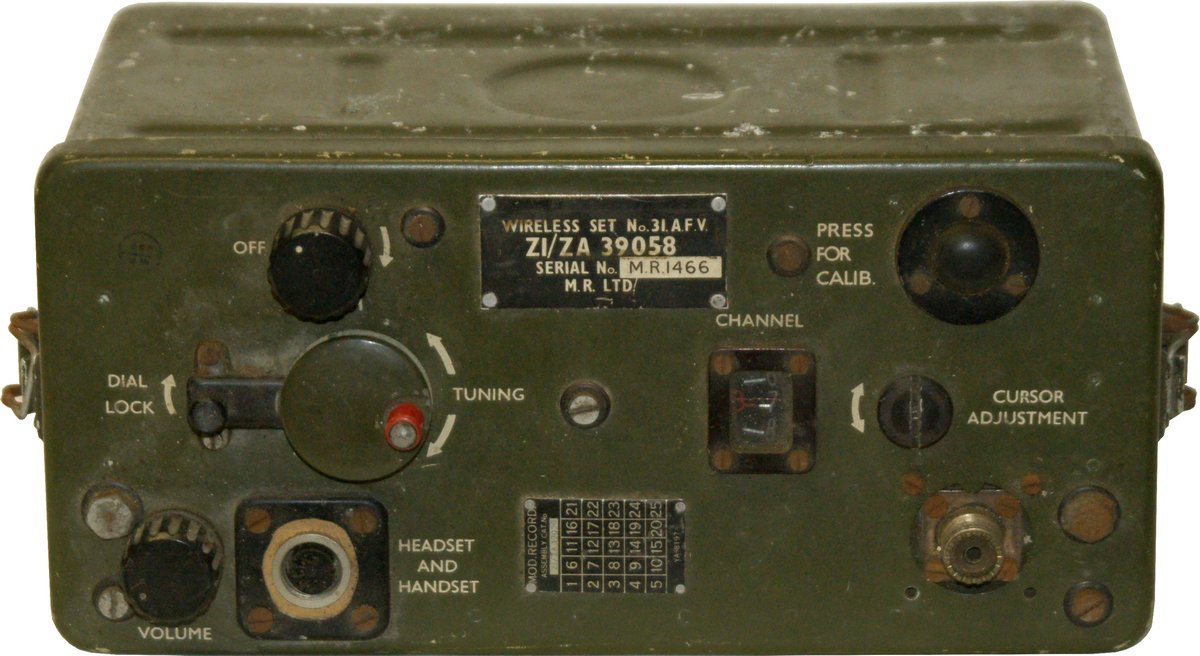
  <figcaption>The front panel of the AFV variant of the 31 Set</figcaption>
</figure>

<p>If it is not already fitted, attach antenna (about five feet long) to special connector (these unique items are nowadays often replaced by collectors with SO-239s as in the picture).</p>

<p>Connect handset or headset to special connector (there was just a tiny bit of standardisation in this as <i>one</i> of the headsets used with the 19 Set would also fit the 31).</p>

<p>Switch on rig with volume control and allow to warm up. Turn squelch off (if one does not do this one never hears anything).</p>

<p>Release the tuning dial lock and turn dial until the CAL indicator is visible in the tuning window (there are two possible calibration frequencies). Press the calibration button and adjust the tuning dial for minimum beat. Then, having released the button, with a coin or the rim of a round adjust the tuning scale cursor until it points exactly to the CAL indicator.</p>

<p>Tune rig to required frequency, lock dial and carry on.</p>

<p>Should this procedure be successful one would achieve FM voice comms with other sets a matter of hundreds of yards away; alas all the 19 Sets at HQ were on armoured rather than infantry frequencies and so net control always had to be another 31 Set, carefully selected and nurtured.</p>

<p>Having done all of this and against all odds found the thing working one would then find that its performance compared only modestly with anything else described as ‘communications equipment’.</p>

<p>One might compare the 31 Set with the modern Baofeng UV-5R which has two bands rather than one, sixteen times the power, at least twice the battery endurance, squelch that works and perhaps one seventy-fifth of the weight, all at an infinitesimal fraction of the cost.</p>

<p>Not long after this I moved to another school, which had no CCF but for no clear reason specialised in politics, to do ‘A’ Levels. Shortly before I left the 31 Sets started to be replaced with <a href="https://en.wikipedia.org/wiki/AN/PRC-10">AN/PRC-10 portable VHF sets</a>; I never saw one of these work at all.</p>]]></content><author><name>Chaz G6UVO</name></author><category term="blog" /><category term="radio history" /><summary type="html"><![CDATA[“You must have had a fun childhood.” Sarah Connor The original SCR-300 with its special connectors At the age of thirteen I was drafted. Having for some time been an inmate in that sort of minor English public school which sees its purpose as feeding Sandhurst and in which the names of the dead go all along the wall of the Chapel and all around the Garden of Remembrance (and not every school even has one of those), and not having the sort of parents who would insist upon, and if necessary pay extra for, some soft option like the so-called ‘Social Service’ (who went around mending things) or the ‘Pioneers’ (who went around breaking them again), or even the Naval Section (about which others must reminisce, the veil of decency having been drawn), I was when the time came duly drafted into the Army section of the CCF. Paris having only recently very nearly fallen to the Situationists someone clearly thought we’d be needed for something real before long and so we did very little of the chocolate soldiering so common in more effete cadet forces (e.g. we once visited another school where all they ever did was incredibly complex marching and counter-marching in a rather showy American manner accompanied by a vast and well equipped band, all this being done in mediaeval ecclesiastical costume) but instead went to cool places and got trained in cool stuff by the likes of the Ghurkas and the SAS. Alas this idyllic state could persist only so long and having completed what they called basic training I then had in theory to choose a specialisation. However the Major in command of the whole circus (who looked, as he was so often reminded, like Klaus Fuchs and who in his spare time taught geography) somehow found out that my father when at the same school some decades previously had distinguished himself by (probably meaning ‘was beaten for’) having made a television receiving set from a war surplus radar tube and some other stuff, and without further ado put me into Signals. The signals section occupied the top floor of a ratty old town house (the middle floor was a photographic darkroom and the ground floor a secondhand school uniform shop) on the other side of the road opposite the school’s ancient Old Hall and the lych-gate. The Major, loving every minute of this, elected to treat it as though it were secret and so apart from wire antennas strung from the top of the house to all kinds of unlikely things and the occasional vertical appearing and disappearing one would not have known that it was there. Inside was like a very low budget but highly technical gentlemen’s club. Refined and sophisticated people sat around in threadbare armchairs or on bar stools drinking tea and eating biscuits and other forms of tuck while dismantling, reassembling, connecting, disconnecting and generally trying to operate any number of 19 Sets in the cosy warm fug commonly created by any sizable conspiracy of thermionic valves and soldering irons. This bourgeois clique, tantamount to an owners’ club, had persuaded the Major that with only another few years of complete peace and quiet they might given certain other technical circumstances be able to connect his private army with the rest of the British one by radio, and had also suggested to anyone less official that with this same provision they might instead be able to arrange the general and inevitable reception of the then fashionable offshore pirate radio stations whose not inconsiderable repertoire consisted of those pop singles which had been banned by the BBC. Alas owing to my being only a Buck Assed Private (we habitually used Vietnam terminology out of sympathy for our unlucky American cousins) none of this Clarkist stuff was for me. Instead those younger and less strategic fellows thought to need exercise to bring them up to the physical fitness standards of the unit were formed into a tactical communications group, issued with 31 Sets and told to get on with it. A museum example of a 31 Set Wireless Set 31 is the British issued version of the Galvin (later Motorola) SCR-300. It is a man portable tactical low VHF FM voice set, its specifications here. It has only 0.3W RF output; this is because tactical radios need to work over just so much distance and no more, lest others overhear. The quoted range is 3 miles, dependent upon terrain and antenna. This equipment was the first ever to be called a ‘walkie-talkie’, and featured in D-Day. There was also a vehicle mobile variant; this variant appears to have survived better than the infantry type and is more commonly found in collections. Wikipedia says: Colonel Ankenbrandt informed General Meade that “they are exactly what is needed for front line communications in this theater”. In his point of view, the main difficulty was keeping them supplied with fresh batteries. Alas by this hangs, heavily, a tale. The set could be powered by either of the BA-70 or BA-80 battery packs. These were specially made by a subcontractor and were dry battery packs of different capacities configured to deliver the three voltages (4.5, 90, 150) required by the set and provided with the connector to match it. Either battery pack could be attached underneath the set to make a reasonably man portable if rather heavy small-rucksack sized item. The heavier BA-70 together with the set weighed nearly forty pounds (17.34kg). Unfortunately as Colonel Ankenbrandt discovered these battery packs were difficult to obtain even during WWII as the subcontractor became progressively less able to supply them. Since WWII they have of course been completely unobtainable even by museums, who habitually exhibit empty battery casings. Accordingly and with a sort of Royal Engineers attitude a technical fix was duly put in. 31 Set empty battery casings being available a sufficiency had been obtained to provide each set with two battery casings instead of one. If memory serves me right they were of slightly different heights so perhaps one was a BA-70 type and the other a BA-80. The combination of rig and two battery boxes stood the best part of three feet high. This Magnum was permanently fastened to a ladder frame aluminium artefact called ‘Carrier Manpack Type 3’ (type 1 illustrated as no other photo found; type 3 I remember to be somewhat longer and narrower but stylistically very similar) and the two battery boxes were filled with dozens and dozens of tiny glass jar type 2V wet-cell accumulators, allegedly once intended to be used in threes to provide 6V for motor scooter electrics somewhere in Europe. These accumulators were considerably smaller than the kind commonly used hitherto for domestic radio receivers, were rectangular rather than square in plan, lacked handles and had their two terminals and stopper in a straight line. There appears to be no photo of such things available. In theory there should have been 75 of these cells to each radio for 150V plate voltage but I never actually counted them. Nor did I ever weigh anything but making reasonable assumptions one might guess that the whole apparatus, radio, boxes, accumulators and carrier, could have weighed as much as thirty kilos, like a large and full bergen. One was expected to carry this impressive item vertically and carefully so that none of the accumulators would spill (the stoppers were not perfectly reliable). This idea was of course somewhat incompatible with that of hurling oneself to the ground when fired upon. There was a sort of yoga movement in which one would pick up the manpack from its position standing vertically on its bottom and carry it off, to deposit it later by a sort of reversal of this procedure, only I always found it much more difficult to put the thing down than to pick it up; perhaps that is why rather more than half a century later I have such a fine collection of hernias. Having picked it up one was then expected to carry the thing to the exercise area, mostly woodland the property of a distant stately home and some two miles and three hundred or so feet of ascent away, to provide communications for some tactical purpose connected with an exercise. The Major made up all these exercises himself, demonstrating his imagination or possibly his taste in films, though many amounted to not much more than ‘Hunt the Slipper’. In the middle of the wood was a forester’s cottage occupied by an actual forester, also belonging to the stately home, who was remarkably tolerant of being woken up at absurd hours owing to his cottage being stormed by burnt cork adorned juvenile delinquents pointing firearms at him and demanding “Where’s the [richly decorated] Plutonium?” In between such times the sets would be charged up, one at a time, by a contraption semi-concealed in the Major’s office as nobody else would give it house room. They were looked after technically, at least in theory, by the cosseted and pampered kulaks of the 19 Set Owners’ Club. Alas by that hangs another tale. As the learned reader can no doubt imagine 75 (if it really was that number) little glass accumulators packed with waste paper and whatnot into their two metal boxes must be connected in series with a similar number of link wires in order to deliver their collective 150V and each and every terminal must be clean, tight and secure for this to happen. Of course lugging the wretched thing a couple of miles in all weathers and generally handling it at all tended to ensure that things became filthy, loose and feral so having got it where it was wanted one would commonly find that it would not work. Quite often the set would wake up and pretend to be working, with the 4.5V heater voltage on, and might perhaps receive, with the 90V HT on, but would refuse to transmit owing to the 150V plate voltage being unavailable. We were not allowed to field strip and reassemble the sets and so if as usual one’s set did not work one simply had to carry it around, sometimes for a whole weekend, to no purpose, and then return it carefully as though it were still precious. In the unlikely event of one’s set working the usual procedure was: The front panel of the AFV variant of the 31 Set If it is not already fitted, attach antenna (about five feet long) to special connector (these unique items are nowadays often replaced by collectors with SO-239s as in the picture). Connect handset or headset to special connector (there was just a tiny bit of standardisation in this as one of the headsets used with the 19 Set would also fit the 31). Switch on rig with volume control and allow to warm up. Turn squelch off (if one does not do this one never hears anything). Release the tuning dial lock and turn dial until the CAL indicator is visible in the tuning window (there are two possible calibration frequencies). Press the calibration button and adjust the tuning dial for minimum beat. Then, having released the button, with a coin or the rim of a round adjust the tuning scale cursor until it points exactly to the CAL indicator. Tune rig to required frequency, lock dial and carry on. Should this procedure be successful one would achieve FM voice comms with other sets a matter of hundreds of yards away; alas all the 19 Sets at HQ were on armoured rather than infantry frequencies and so net control always had to be another 31 Set, carefully selected and nurtured. Having done all of this and against all odds found the thing working one would then find that its performance compared only modestly with anything else described as ‘communications equipment’. One might compare the 31 Set with the modern Baofeng UV-5R which has two bands rather than one, sixteen times the power, at least twice the battery endurance, squelch that works and perhaps one seventy-fifth of the weight, all at an infinitesimal fraction of the cost. Not long after this I moved to another school, which had no CCF but for no clear reason specialised in politics, to do ‘A’ Levels. Shortly before I left the 31 Sets started to be replaced with AN/PRC-10 portable VHF sets; I never saw one of these work at all.]]></summary></entry><entry><title type="html">Christmas Meal Celebrating A Good Year</title><link href="http://0.0.0.0:4000/2025/12-06-christmas-meal-celebrating-a-good-year.html" rel="alternate" type="text/html" title="Christmas Meal Celebrating A Good Year" /><published>2025-12-06T00:00:00+00:00</published><updated>2025-12-06T00:00:00+00:00</updated><id>http://0.0.0.0:4000/2025/christmas-meal-celebrating-a-good-year</id><content type="html" xml:base="http://0.0.0.0:4000/2025/12-06-christmas-meal-celebrating-a-good-year.html"><![CDATA[We celebrated a good year at the Christmas meal - we had twelve join us for our Chirstmas meal at the King Alfred pub in Street which was good value. It has been five years since our [last one in 2019]({% post_url 2019-12-20-christmas-meal-celebrating-a-successful-year %})

{% include figure image_path="/assets/2025/PC060006.jpg" caption = "L-R Steve, Martin, Jay and IoAARC Chairman Matt (R)" %}

Please note that there is no Club meeting on Boxing Day]]></content><author><name>IoAARC</name></author><category term="events" /><category term="Christmas" /><summary type="html"><![CDATA[We celebrated a good year at the Christmas meal - we had twelve join us for our Chirstmas meal at the King Alfred pub in Street which was good value. It has been five years since our last one in 2019 L-R Steve, Martin, Jay and IoAARC Chairman Matt (R) Please note that there is no Club meeting on Boxing Day]]></summary></entry><entry><title type="html">Exercise Blue Ham</title><link href="http://0.0.0.0:4000/2025/10-18-exercise-blue-ham.html" rel="alternate" type="text/html" title="Exercise Blue Ham" /><published>2025-10-18T00:00:00+01:00</published><updated>2025-10-18T00:00:00+01:00</updated><id>http://0.0.0.0:4000/2025/exercise-blue-ham</id><content type="html" xml:base="http://0.0.0.0:4000/2025/10-18-exercise-blue-ham.html"><![CDATA[We [last did]({% post_url  2025-03-29-exercise-blue-ham %}) Exercise Blue Ham this Spring, we missed one in the summer due to availability of operators over the weekend, it's good to do this again this Autumn. Another lovely sunny day. We rigged the antenna on Friday evening on club night. We had to lower the antenna in the dark to repair the masthead balun which must have been dropped at some stage causing three out of four solder connections to fail, thankfully the large ferrite core was still intact and the antenna was back in service by Friday night.

John G8VZA did a great job on the operating position on Saturday along with Chaz G6UVO who worked a lot of stations on both days as well as doing logging for other operators.

We contacted over 70 cadet stations over the weekend. We involved our trainee Gary who got several new cadet stations for us

{% include figure image_path="/assets/2025/25-10-19-PA190016.jpg" caption="IOAARC Chairman Matt now M9MIM operating club station MX0IOA" %} 

and we put relatively newly licensed Nigel M7IZJ in the hot seat on the Club station and he did very well under pressure garnering three MRE cadet stations with only a few minutes rough outlining of what it's all about, nice one!

{% include figure image_path="/assets/2025/25-10-19-PA190017.jpg" caption="Nigel M7IZJ operating Club station MX0IOA with MRE11 cadet station" %} 

The band was in very good condition for NVIS operation. The cadet stations were using a variety of rigs the Icom IC7300 seemed a clear favourite. Good signals all round, most today were LC (loud and Clear, 59) with good [NVIS](#nvis) operation to most of the stations.

{% include figure image_path="/assets/2025/2025-10-18-PA180012.jpg" caption="Exercise Blue Ham antenna, rigged north-south" %} 

We had an enjoyable weekend contacting cadet stations on the 5MHz band. Well done cadets and RAFAC for putting the show on. Congratulations SOTA operator M1EYP/P who was out in the wet weather on Sunday activating a summit, we gave him a shout and he worked quite a few Cadet stations too. The cadets worked at least on DL station and a few PA stations, nice to get a taste of international working.

## notes on the cadets' stations

RAFAC's cadets were using more recent rigs than in previous exercises, the IC7300 ws the most common rig used, followed by a few Yaesu FT10DX rigs. The oldest rig I noted was a IC706, There weren't any Clansmans in use that we noted, there had been one in service [in 2022]({% post_url 2022-03-27-operation-blue-ham-result %}). 

The band was in very good condition on Saturday and reasonably good on Sunday, tending to fade with increasing QSB around 4pm BST.

Antennas were a combination of horizontal dipoles and G5RVs in the main, with a few doublets, end-fed half-waves and longwires. One station used a horizontal loop antenna (not a mag loop) and on Sunday there was a mag loop in service in Wales.

One unusual antenna was in the east of the country, an EFSW. End-fed short wire, 20m long and about 2m above the ground[^1]. The low EFSW is reminiscent of the philosophy behind [this article by VE2DPE](https://www.hamradiosecrets.com/nvis-antenna.html). Although he is using a loaded dipole, he says the effect of the low height about ground improves the SNR for NVIS signals specifically, at the cost of lower signal strength on receive, and more ground losses on TX. 

[NVIS propagation](#nvis) uses the F-layer that can be up to 300km high so round-trip path lengths are < ~1000km. VE2DPE's thesis is that extra ground losses are tolerable - losses on RX are made up due to the high background noise at HF, so the noise figure is not impaired by a less sensitive antenna with gain made up with a preamp. Higher ground losses on TX are acceptable due to the modest path length, this is not DX. We worked this station which was in the east of the country repeatedly so the 20m EFSW was quite serviceable in this use case

We observed no particular different signal strengths in cadet stations usng horizontal dipoles orientated in a different direction to our NVIS dipole which was rigged broadly N/S.

## Exercise Blue Ham certificate 

{% include figure image_path="/assets/2025/2025-10-22BH_Certificate_Oct.png" caption="Exercise Blue Ham [certificate from RAFAC](/assets/2025/2025-10-22BH_Certificate_Oct.pdf)" %} 

## Near Vertical Incidence Skywave (NVIS) {#nvis}

The [RSGB highlights](https://rsgb.org/main/blog/front-page-news/2017/03/17/near-vertical-incidence-skywave-research-paper/) [this paper](https://link.springer.com/article/10.1007/s11235-017-0287-2) showing the principles 

> NVIS propagation may be used to cover an area with a 200 km radius using low power and simple antennas [...] a modest transmit power of 20 W in a dipole antenna will produce more than 30 dB signal-to-noise ratio (SNR) in a 3 kHz bandwidth. [...] This SNR is constant over the entire coverage area and does not decay with increasing distance.

{% include figure image_path="/assets/2019/nvis.gif" caption="In Near Vertical Incidence Skywave (NVIS) communications, electromagnetic waves sent nearly vertically towards the ionosphere are reflected and land in the area around the transmitter" %} 

More about [NVIS](https://en.wikipedia.org/wiki/Near_vertical_incidence_skywave) on wikipedia

## about Exercise Blue Ham

Blue Ham exercises provide a platform to further develop Cadet radio operator skill and confidence by engaging with the Amateur radio community via the MOD 5MHz (Shared) Band. [More from RAFAC](https://alphacharlie.org.uk/exercise-blue-ham/), and there is a [log page](https://blueham.alphacharlie.org.uk/showhamscore.php)[^2] and [map of stations](https://blueham.alphacharlie.org.uk/showmap.php)

[^1]: I don't have the MX0IOA log in front of me so this is from memory, it could be 2ft a.g.l. but that sounds unlikely

[^2]: that [log page](https://blueham.alphacharlie.org.uk/showhamscore.php) gets overwritten with the next exercise, so it's only valid for a couple of months or so.]]></content><author><name>IoAARC</name></author><category term="events" /><category term="blue ham" /><summary type="html"><![CDATA[We last did Exercise Blue Ham this Spring, we missed one in the summer due to availability of operators over the weekend, it’s good to do this again this Autumn. Another lovely sunny day. We rigged the antenna on Friday evening on club night. We had to lower the antenna in the dark to repair the masthead balun which must have been dropped at some stage causing three out of four solder connections to fail, thankfully the large ferrite core was still intact and the antenna was back in service by Friday night. John G8VZA did a great job on the operating position on Saturday along with Chaz G6UVO who worked a lot of stations on both days as well as doing logging for other operators. We contacted over 70 cadet stations over the weekend. We involved our trainee Gary who got several new cadet stations for us IOAARC Chairman Matt now M9MIM operating club station MX0IOA and we put relatively newly licensed Nigel M7IZJ in the hot seat on the Club station and he did very well under pressure garnering three MRE cadet stations with only a few minutes rough outlining of what it’s all about, nice one! Nigel M7IZJ operating Club station MX0IOA with MRE11 cadet station The band was in very good condition for NVIS operation. The cadet stations were using a variety of rigs the Icom IC7300 seemed a clear favourite. Good signals all round, most today were LC (loud and Clear, 59) with good NVIS operation to most of the stations. Exercise Blue Ham antenna, rigged north-south We had an enjoyable weekend contacting cadet stations on the 5MHz band. Well done cadets and RAFAC for putting the show on. Congratulations SOTA operator M1EYP/P who was out in the wet weather on Sunday activating a summit, we gave him a shout and he worked quite a few Cadet stations too. The cadets worked at least on DL station and a few PA stations, nice to get a taste of international working. notes on the cadets’ stations RAFAC’s cadets were using more recent rigs than in previous exercises, the IC7300 ws the most common rig used, followed by a few Yaesu FT10DX rigs. The oldest rig I noted was a IC706, There weren’t any Clansmans in use that we noted, there had been one in service in 2022. The band was in very good condition on Saturday and reasonably good on Sunday, tending to fade with increasing QSB around 4pm BST. Antennas were a combination of horizontal dipoles and G5RVs in the main, with a few doublets, end-fed half-waves and longwires. One station used a horizontal loop antenna (not a mag loop) and on Sunday there was a mag loop in service in Wales. One unusual antenna was in the east of the country, an EFSW. End-fed short wire, 20m long and about 2m above the ground1. The low EFSW is reminiscent of the philosophy behind this article by VE2DPE. Although he is using a loaded dipole, he says the effect of the low height about ground improves the SNR for NVIS signals specifically, at the cost of lower signal strength on receive, and more ground losses on TX. NVIS propagation uses the F-layer that can be up to 300km high so round-trip path lengths are &lt; ~1000km. VE2DPE’s thesis is that extra ground losses are tolerable - losses on RX are made up due to the high background noise at HF, so the noise figure is not impaired by a less sensitive antenna with gain made up with a preamp. Higher ground losses on TX are acceptable due to the modest path length, this is not DX. We worked this station which was in the east of the country repeatedly so the 20m EFSW was quite serviceable in this use case We observed no particular different signal strengths in cadet stations usng horizontal dipoles orientated in a different direction to our NVIS dipole which was rigged broadly N/S. Exercise Blue Ham certificate Exercise Blue Ham certificate from RAFAC Near Vertical Incidence Skywave (NVIS) The RSGB highlights this paper showing the principles NVIS propagation may be used to cover an area with a 200 km radius using low power and simple antennas […] a modest transmit power of 20 W in a dipole antenna will produce more than 30 dB signal-to-noise ratio (SNR) in a 3 kHz bandwidth. […] This SNR is constant over the entire coverage area and does not decay with increasing distance. In Near Vertical Incidence Skywave (NVIS) communications, electromagnetic waves sent nearly vertically towards the ionosphere are reflected and land in the area around the transmitter More about NVIS on wikipedia about Exercise Blue Ham Blue Ham exercises provide a platform to further develop Cadet radio operator skill and confidence by engaging with the Amateur radio community via the MOD 5MHz (Shared) Band. More from RAFAC, and there is a log page2 and map of stations I don’t have the MX0IOA log in front of me so this is from memory, it could be 2ft a.g.l. but that sounds unlikely &#8617; that log page gets overwritten with the next exercise, so it’s only valid for a couple of months or so. &#8617;]]></summary></entry><entry><title type="html">Receiving images for Space Week from the International Space Station</title><link href="http://0.0.0.0:4000/2025/10-03-ariss.html" rel="alternate" type="text/html" title="Receiving images for Space Week from the International Space Station" /><published>2025-10-03T00:00:00+01:00</published><updated>2025-10-03T00:00:00+01:00</updated><id>http://0.0.0.0:4000/2025/ariss</id><content type="html" xml:base="http://0.0.0.0:4000/2025/10-03-ariss.html"><![CDATA[We received these pictures in Glastonbury directly from the International Space Station using slow scan TV (SSTV), the theme this time  is [World Space Week](https://www.worldspaceweek.org/about/) Oct 4-10.

{% include gallery caption="International Space Station (ISS) pictures received directly from space to Glastonbury" %}

A different approach this time, using a turnstile antenna[^1] - two 2m dipoles at 90 degrees, one of them fed by a 90degree phase shift (¼λ of cable) for a more or less circular pickup pattern in the horizontal plane.

{% include figure image_path="/assets/2025/DSCN5330.JPG" caption="The turnstile antenna" %}

[^1]: based on [this description](http://www.open-circuit.co.uk/turns.php)]]></content><author><name>Richard G7LEE</name></author><category term="events" /><category term="ISS" /><category term="SSTV" /><summary type="html"><![CDATA[We received these pictures in Glastonbury directly from the International Space Station using slow scan TV (SSTV), the theme this time is World Space Week Oct 4-10. International Space Station (ISS) pictures received directly from space to Glastonbury A different approach this time, using a turnstile antenna1 - two 2m dipoles at 90 degrees, one of them fed by a 90degree phase shift (¼λ of cable) for a more or less circular pickup pattern in the horizontal plane. The turnstile antenna based on this description &#8617;]]></summary></entry><entry><title type="html">Railways on the Air station GB0ESR</title><link href="http://0.0.0.0:4000/2025/09-28-rota.html" rel="alternate" type="text/html" title="Railways on the Air station GB0ESR" /><published>2025-09-28T00:00:00+01:00</published><updated>2025-09-28T00:00:00+01:00</updated><id>http://0.0.0.0:4000/2025/rota</id><content type="html" xml:base="http://0.0.0.0:4000/2025/09-28-rota.html"><![CDATA[This is an event organised by [MidSARC](https://www.midsarc.radio/) who have done all the hard work in setting up the station and operating. John G8VZA volunteers with the [East Somerset Railway](https://eastsomersetrailway.com/) so thanks and kudos to the guys at MidSARC. Matt 2E0FNT and myself G7LEE gave a hand with operating on Sunday. I worked a few of the other railways on Sunday afternoon on HF, but Simon and Dave did the vast majority of the work filling four A4 log sheets on 40m, well done guys. 2m was a bit flat on Sunday, there was the Weston rally so fewer stations on the air.

{% include figure image_path="/assets/2025/IMG_1074.jpg" caption="John G8VZA at the VHF station" %} 

{% include figure image_path="/assets/2025/IMG_1077.jpg" caption="Simon G8DMN on the HF station" %} 

{% include figure image_path="/assets/2025/IMG_1098.jpg" caption="Rik M0RKM on the right at the moving VHF station GB0ESR/P note the Slim Jim on the left" %} 

{% include figure image_path="/assets/2025/IMG_1113.jpg" caption="Matt 2E0FNT on the VHF station" %} 

{% include figure image_path="/assets/2025/IMG_1141.jpg" caption="Callum M7AJO on the VHF station" %} 

Operating from the moving train was always going to be a challenge, Matt worked two stations from the train as GB0ESR/P at 11:40 but we had to use the [GB3WR repeater](https://www.gb3wr.uk/)

{% include figure image_path="/assets/2025/IMG_1138.jpg" caption="Matt 2E0FNT operating GB0ESR/P on the train, contacting Derrick M0WOB via GB3WR repeater as the 2m takeoff from Mendip Vale wasn't ideal" %} 

<figure class="third">
<img src="/assets/2025/IMG_1090.jpg">
<img src="/assets/2025/IMG_1095.jpg">
<img src="/assets/2025/IMG_1106.jpg">
  <figcaption>You can't have a post about trains without some pictures of trains</figcaption>
</figure>

{% include rm_audio url="/assets/2025/2025-09-28-gb0esr-182.mp3" %}

We had gorgeous weather and the line was in steam, so some great background SFX for some of the contacts! Note there's a steam whistle at 7s in so don't wind the volume up too much!

{% include figure image_path="/assets/2025/IMG_1125.jpg" caption="The G5RV HF antenna with the 2m antenna on the top" %} 

All in all good fun and thanks very much to the team at [MidSARC](https://www.midsarc.radio/) and John G8VZA for arranging a great operating position on the platform for us.]]></content><author><name>Richard G7LEE</name></author><category term="events" /><summary type="html"><![CDATA[This is an event organised by MidSARC who have done all the hard work in setting up the station and operating. John G8VZA volunteers with the East Somerset Railway so thanks and kudos to the guys at MidSARC. Matt 2E0FNT and myself G7LEE gave a hand with operating on Sunday. I worked a few of the other railways on Sunday afternoon on HF, but Simon and Dave did the vast majority of the work filling four A4 log sheets on 40m, well done guys. 2m was a bit flat on Sunday, there was the Weston rally so fewer stations on the air. John G8VZA at the VHF station Simon G8DMN on the HF station Rik M0RKM on the right at the moving VHF station GB0ESR/P note the Slim Jim on the left Matt 2E0FNT on the VHF station Callum M7AJO on the VHF station Operating from the moving train was always going to be a challenge, Matt worked two stations from the train as GB0ESR/P at 11:40 but we had to use the GB3WR repeater Matt 2E0FNT operating GB0ESR/P on the train, contacting Derrick M0WOB via GB3WR repeater as the 2m takeoff from Mendip Vale wasn’t ideal You can't have a post about trains without some pictures of trains Your browser does not support the audio element. We had gorgeous weather and the line was in steam, so some great background SFX for some of the contacts! Note there’s a steam whistle at 7s in so don’t wind the volume up too much! The G5RV HF antenna with the 2m antenna on the top All in all good fun and thanks very much to the team at MidSARC and John G8VZA for arranging a great operating position on the platform for us.]]></summary></entry><entry><title type="html">The Blaw-Knox tower: visual symbol of radio</title><link href="http://0.0.0.0:4000/2025/09-15-blaw-knox-tower.html" rel="alternate" type="text/html" title="The Blaw-Knox tower: visual symbol of radio" /><published>2025-09-15T00:00:00+01:00</published><updated>2025-09-15T00:00:00+01:00</updated><id>http://0.0.0.0:4000/2025/blaw-knox-tower</id><content type="html" xml:base="http://0.0.0.0:4000/2025/09-15-blaw-knox-tower.html"><![CDATA[In 1927 the [Blaw-Knox](https://en.wikipedia.org/wiki/Blaw-Knox) engineering company, formed by a merger between two US steelworking firms founded some years earlier, started manufacturing [towers](https://en.wikipedia.org/wiki/Blaw-Knox_tower) for AM radio broadcast stations to use as antennas.

Blaw-Knox designers came up with an unique form for these towers: two tall pyramids with their common base roughly half-way up the tower, surrounded by a ring of guys, usually four but sometimes as many as eight. This design made the tower strong and relatively easy to construct.


{% include figure image_path="/assets/2025/Lakihegyi_adotorony_1.jpg" caption="Taller than the Mendip TV mast, this Blaw-Knox in Hungary has eight guys and is the tallest survivor at 314m" %} 

The towers were always used as radiators, like huge whip aerials, mounted on a massive insulating base and with their guys broken up by insulators into non-resonant sections.

Unfortunately the laws of physics have it that diamond-shaped antennas are not quite such effective radiators in the horizontal plane as are simple parallel-sided masts. Messrs. Blaw-Knox made these too, but later found that their road-paving machines were much better business for them and it is these which as a division of Volvo they still make.

The diamond-shaped antenna however had become a very definite symbol of radio broadcasting and was much beloved by all. Some radio stations like WLW-AM, whose Blaw-Knox was installed in 1934, continue to use them today (along with the word 'iconic'). Perhaps half a dozen remain in operation worldwide as reminders of the Age of the Dictators.

{% include figure image_path="/assets/2025/WLW-AM_RadioTower.jpg" caption="WLW-AM radio tower - The shape and the power of the voice" %} 

So firmly is the tall diamond established as a symbol of radio that it forms the basis of the logos of a number of well-known radio amateur organisations

<figure class="third">
<img src="/assets/2025/rsgb_logo_large_transparent_background.png">
<img src="/assets/2025/arrl.png">
<img src="/assets/2025/raynet.gif">
  <figcaption>RSGB, ARRL and RAYNET logos</figcaption>
</figure>
It could be argued that this is all rather ironic as a Blaw-Knox tower was always a huge undertaking ("At Colossal Cost, and Enormous Expense!"), entirely beyond the means of the radio amateur; there is no record of any Blaw-Knox having ever been used for amateur purposes.

Despite which as part of a general upgrade of Club things our resident graphic designer Petra M7PAH is looking at creating a new logo for the Club and drawings for this so far are all somewhat diamond-shaped.]]></content><author><name>Chaz G6UVO</name></author><category term="blog" /><category term="IoAARC admin" /><summary type="html"><![CDATA[In 1927 the Blaw-Knox engineering company, formed by a merger between two US steelworking firms founded some years earlier, started manufacturing towers for AM radio broadcast stations to use as antennas. Blaw-Knox designers came up with an unique form for these towers: two tall pyramids with their common base roughly half-way up the tower, surrounded by a ring of guys, usually four but sometimes as many as eight. This design made the tower strong and relatively easy to construct. Taller than the Mendip TV mast, this Blaw-Knox in Hungary has eight guys and is the tallest survivor at 314m The towers were always used as radiators, like huge whip aerials, mounted on a massive insulating base and with their guys broken up by insulators into non-resonant sections. Unfortunately the laws of physics have it that diamond-shaped antennas are not quite such effective radiators in the horizontal plane as are simple parallel-sided masts. Messrs. Blaw-Knox made these too, but later found that their road-paving machines were much better business for them and it is these which as a division of Volvo they still make. The diamond-shaped antenna however had become a very definite symbol of radio broadcasting and was much beloved by all. Some radio stations like WLW-AM, whose Blaw-Knox was installed in 1934, continue to use them today (along with the word ‘iconic’). Perhaps half a dozen remain in operation worldwide as reminders of the Age of the Dictators. WLW-AM radio tower - The shape and the power of the voice So firmly is the tall diamond established as a symbol of radio that it forms the basis of the logos of a number of well-known radio amateur organisations RSGB, ARRL and RAYNET logos It could be argued that this is all rather ironic as a Blaw-Knox tower was always a huge undertaking (“At Colossal Cost, and Enormous Expense!”), entirely beyond the means of the radio amateur; there is no record of any Blaw-Knox having ever been used for amateur purposes. Despite which as part of a general upgrade of Club things our resident graphic designer Petra M7PAH is looking at creating a new logo for the Club and drawings for this so far are all somewhat diamond-shaped.]]></summary></entry><entry><title type="html">Beacon Batch club SOTA activation</title><link href="http://0.0.0.0:4000/2025/07-30-beacon-batch.html" rel="alternate" type="text/html" title="Beacon Batch club SOTA activation" /><published>2025-07-30T00:00:00+01:00</published><updated>2025-07-30T00:00:00+01:00</updated><id>http://0.0.0.0:4000/2025/beacon-batch</id><content type="html" xml:base="http://0.0.0.0:4000/2025/07-30-beacon-batch.html"><![CDATA[Club chairman Matt 2E0FNT, Trainee Gary (working supervised by Matt so also 2E0FNT) and I activated Beacon Batch, whih is our local nearest summit. Plan was to activate on FM, this was going to be an easy win as our club net is on Wednesdays. I had the idea of activating on 20m sp I used a KX3 with a [flowerpot antenna](https://vk2zoi.com/articles/half-wave-flower-pot/). My FPA uses two Vango tent pole repair poles to hold the coax antenna, with a connector join in the middle so it folds down to the length of a tent pole element. The KX3 is only good for a weedy 3W but it got out to Scott GW7SAB in Newport 

Matt did all the hard work ;) I (G7LEE) can't take pictures, check the location out for HF suitability and debug my radio gear and activate at the same time. I've had the pleasure of activating [Wills Neck]({% post_url  2022-08-04-wills-neck %}) a while ago so it was Matt's turn. Wills Neck is SOTA ref [G/SC-002](https://www.sotadata.org.uk/en/summit/G/SC-002), probably POTA [GB-0321](https://pota.app/#/park/GB-0321)

I was coming back from Exmoor and Matt was available on this Tuesday. You wouldn't necessarily choose a Tuesday lunchime for 2m contacts, Matt managed 10 contacts. It'd have been great to have resoved the S2S to mid-Wales but it just wasn't quite there, that's the challenge and the joy of radio ;) 

{% include figure image_path="/assets/2025/P7080085.jpg" caption="Matt 2E0FNT with rig at the trig point" %} 

Matt used his Anytone AT878DUV handheld with a tactical antenna, which appears to be a foldable piece of steel tape measure, operating from the trig point using a handheld speaker mic. 

### contacts

|time | call | name | freq |
|===|===|===|
| 1245 | G8VZA | John | 145.475 |
| 1245 | G7KTE | Peter | 145.475 |
| 1250 | GW4SRR | Simon | 145.475 |
| 1255 | MW7VVX | Shaun | 145.475 |
| 1244 | G4UVZ | Adrian | 145.450 |
| 1312 | M0WYB | Russ | 145.475 |
| 1316 | 2W0OGY| Chris | 145.475 |
| 1330 | M6MQB | Matt | 145.475 |
| 1340 | M7MFS | Matt | 145.475 |
| 1343 | GW8LGX | Steve | 145.475 |
| 1356 | 2W0LIQ | John | 145.475 |

Takeoff from Wills Neck is pretty good all round. G7KTE was in Brixham on the south Devon coast.

This is Matt received by M6MQB in Glastonbury

![Anytone pic](/assets/2025/2025-07-08-anytone.jpg)

{% include rm_audio url="/assets/2025/2025-07-08-wills-neck.wav" %}


### observations

I made a contact with M6MQB on 433.475 at about 13:35, there was no cross-band QRM with 2E0FNT. However, when I tried calling a C4FM call on the DV calling channel of 144.6125 I could hear I was causing background QRM[^10] on Matt's rig, so I knocked it off. 

[^10]: Digital voice QRM sounds like a horrible buzz on analogue, which is why the [UK DV calling frequency](https://rsgb.services/public/bandplans/html/250220_rsgb_band_plan_2025.htm) of 144.6125MHz is far away from the analogue calling frequency of 145.500.

I learned from M6MQB that the power my 30 year old Kenwood TH-D7e started to fade on 70cm after a few seconds, on a [previous activation]({% post_url 2022-06-14-sota-beacon-batch %}#fixing-the-kenwood-th-d7) I discovered this rig was off frequency on 70cm (corrected after that experience) so perhaps it's time to accept that rig is a sick puppy and retire it. It did show that there's a notable audio delay on the FT3DE on reception, I heard Matt in realtime on the Kenwood but it sounded like there was a slap-echo on the FT3DE.

I wanted to see what the potential of this site was for HF. Although the summit is largely low scrub, there are a few trees which could support a fibreglass pole.

{% include figure image_path="/assets/2025/P7080090.jpg" caption="There's reasonable HF potential with a few trees to support an antenna near the trig point in the 25m elevation SOTA activation zone" %} 

We started out from the Lydeard Hill car park near West Bagborough at ST180338. The car park at Triscombe Stone ST163359 is closer, but starts lower down and would have used more fuel coming from Taunton. There's a [report from 2023](https://www.sotadata.org.uk/en/summits/article/25923/view) that the road to Triscombe Stone may not be passable any more.]]></content><author><name>Richard G7LEE</name></author><category term="events" /><category term="SOTA" /><summary type="html"><![CDATA[Club chairman Matt 2E0FNT, Trainee Gary (working supervised by Matt so also 2E0FNT) and I activated Beacon Batch, whih is our local nearest summit. Plan was to activate on FM, this was going to be an easy win as our club net is on Wednesdays. I had the idea of activating on 20m sp I used a KX3 with a flowerpot antenna. My FPA uses two Vango tent pole repair poles to hold the coax antenna, with a connector join in the middle so it folds down to the length of a tent pole element. The KX3 is only good for a weedy 3W but it got out to Scott GW7SAB in Newport Matt did all the hard work ;) I (G7LEE) can’t take pictures, check the location out for HF suitability and debug my radio gear and activate at the same time. I’ve had the pleasure of activating Wills Neck a while ago so it was Matt’s turn. Wills Neck is SOTA ref G/SC-002, probably POTA GB-0321 I was coming back from Exmoor and Matt was available on this Tuesday. You wouldn’t necessarily choose a Tuesday lunchime for 2m contacts, Matt managed 10 contacts. It’d have been great to have resoved the S2S to mid-Wales but it just wasn’t quite there, that’s the challenge and the joy of radio ;) Matt 2E0FNT with rig at the trig point Matt used his Anytone AT878DUV handheld with a tactical antenna, which appears to be a foldable piece of steel tape measure, operating from the trig point using a handheld speaker mic. contacts time call name freq 1245 G8VZA John 145.475 1245 G7KTE Peter 145.475 1250 GW4SRR Simon 145.475 1255 MW7VVX Shaun 145.475 1244 G4UVZ Adrian 145.450 1312 M0WYB Russ 145.475 1316 2W0OGY Chris 145.475 1330 M6MQB Matt 145.475 1340 M7MFS Matt 145.475 1343 GW8LGX Steve 145.475 1356 2W0LIQ John 145.475 Takeoff from Wills Neck is pretty good all round. G7KTE was in Brixham on the south Devon coast. This is Matt received by M6MQB in Glastonbury Your browser does not support the audio element. observations I made a contact with M6MQB on 433.475 at about 13:35, there was no cross-band QRM with 2E0FNT. However, when I tried calling a C4FM call on the DV calling channel of 144.6125 I could hear I was causing background QRM1 on Matt’s rig, so I knocked it off. I learned from M6MQB that the power my 30 year old Kenwood TH-D7e started to fade on 70cm after a few seconds, on a previous activation I discovered this rig was off frequency on 70cm (corrected after that experience) so perhaps it’s time to accept that rig is a sick puppy and retire it. It did show that there’s a notable audio delay on the FT3DE on reception, I heard Matt in realtime on the Kenwood but it sounded like there was a slap-echo on the FT3DE. I wanted to see what the potential of this site was for HF. Although the summit is largely low scrub, there are a few trees which could support a fibreglass pole. There’s reasonable HF potential with a few trees to support an antenna near the trig point in the 25m elevation SOTA activation zone We started out from the Lydeard Hill car park near West Bagborough at ST180338. The car park at Triscombe Stone ST163359 is closer, but starts lower down and would have used more fuel coming from Taunton. There’s a report from 2023 that the road to Triscombe Stone may not be passable any more. Digital voice QRM sounds like a horrible buzz on analogue, which is why the UK DV calling frequency of 144.6125MHz is far away from the analogue calling frequency of 145.500. &#8617;]]></summary></entry><entry><title type="html">Receiving images from the International Space Station</title><link href="http://0.0.0.0:4000/2025/07-15-ariss.html" rel="alternate" type="text/html" title="Receiving images from the International Space Station" /><published>2025-07-15T00:00:00+01:00</published><updated>2025-07-15T00:00:00+01:00</updated><id>http://0.0.0.0:4000/2025/ariss</id><content type="html" xml:base="http://0.0.0.0:4000/2025/07-15-ariss.html"><![CDATA[We received these pictures in Glastonbury directly from the International Space Station using slow scan TV (SSTV).  

{% include gallery caption="International Space Station (ISS) pictures received directly from space to Glastonbury" %}

AMSAT has details of the activity period in [mid-July](https://amsat-uk.org/2025/07/11/sstv-from-the-iss-in-july/) Our first reasonably successful image passed over Glastonbury on the 15th July at 18:22 UTC 
{% include figure image_path="/assets/2025/ariss/04-20250715-1822-PD120mm_sm.jpg" caption="Picture received from ISS in Glastonbury 16 Jul 20:46 UTC horiz dipole" %}

There's something curiously meta about the first image being a SSTV image of an SSTV image from 40 years ago. The images are of the STS-51F Shuttle launch on the 29th July 1985. One engine out of three failed and the [mission was aborted to orbit](https://appel.nasa.gov/2022/07/12/this-month-in-nasa-history-sts-51-f/) - taking up a lower orbit that planned because it was already past the point of no return when the engine failure occurred.

{% include figure image_path="/assets/2025/ariss/2025-07-15-1822z-sts51f01.jpg" caption="Ground track of the ISS for ths capture" %}

Because this is low and at a distance I used a X510 collinear into an RSP1. 

## equipment used and setup

Equipment was set up similar to [last time in 2021]({% post_url  2021-06-22-more-ariss %}). This time I had more success with overhead passes and the horizontal dipole. The RSP-1 has an AFC command in the extended menu, and I used this to track the Doppler shift of the signal as it passes overhead, it can be +3kHz to -1kHz (my elevation horizon is limited to the east). The AFC only works when the signal is strong enough to be heard clearly, I toggle it off in fades and back on again. It is easier to optimise the signal without de-emphasis as the crackle is louder as the signal weakens. I record the signal without de-emphasis to feed into MMSSTV - SSTV is a FM baseband signal carried on a FM carrier so image brightness and colour difference is carried in the zero-crossings.

{% include figure image_path="/assets/2025/ariss/02-20250716-2046-PD120mm_sm.jpg" caption="Clean picture received from ISS in Glastonbury 16 Jul 20:46 UTC with horizontal dipole" %}

I use [Heavens Above](https://heavens-above.com/PassSummary.aspx?satid=25544) for predictions. This can only give you a prediction if you log in and set your location, note that the times given are in local time (BST at the moment) not UTC. Remember to tick the 'all passes' box - you aren't trying to see the ISS visually.

A transmission is usually in progress by the time you acquire the signal, this will be a partial image so I tried rotating the antenna to see if there is any value in trying to angle it perpendicular to the line of flight. There doesn't seem much in it, the default orientation of the dipole N-S is good enough.

## ARISS Diploma

You get a nice ticket for a successful receive if you upload it to [ARISS usa](https://ariss-usa.org/ARISS_SSTV/)

{% include figure image_path="/assets/2025/2025-07-30-ariss-diploma.jpg" caption="ARISS diploma" %}

and a little bit more about the mission and these pictures

> The images of the SSTV series 28 refer to two important events.  
>  
>This year marks the 50th anniversary of the Soyuz-Apollo space mission, also known as the ASTP (Apollo-Soyuz Test Project), which was a joint space project of the USSR (Russia) and the United States. Its purpose was to dock the Soyuz and Apollo spacecraft in orbit. This mission, carried out in July 1975, was the beginning of cooperation between the two countries in space exploration.
On July 15, 1975, the Saturn IB rocket with the Apollo command module and docking module launched from Cape Canaveral. On the same day, a Soyuz rocket took off from the Baikonur Cosmodrome, carrying the Soyuz 19 spacecraft. The docking of the Apollo and Soyuz spacecraft took place on July 17, 1975. The crews spent several days in orbit together.  
>  
>40 years ago, Tony England W0ORE during the Challenger shuttle mission STS 51-F in 1985, he achieved the first ever two-way Slow Scan TV (SSTV) space contact.  
>Tony was running a Motorola model MX-340 handheld 2-meter transceiver and a Robot Research model 1200C slow-scan television scan converter with an antenna fitted on the inside of one of Challengers windows.  
>STS-51-F (also known as Spacelab 2) was the nineteenth flight of NASA’s Space Shuttle program, and the eighth flight of Space Shuttle Challenger. It launched from Kennedy Space Center, Florida, on 29 July 1985, and landed at Edwards Air Force Base, California, just under eight days later on 6 August 1985, at 12:45:26 pm PDT.  
>  
>The diploma shows the Apollo and Soyuz spacecraft approaching each other in orbit, as well as a photograph of Tony England. 

## Collinear vs horizontal dipole

A typical collinear 2m antenna favours the horizon and often has a dead spot vertically overhead. It may have lobes in the vertical plane, as the ISS passes it may go through these. On the other hand a low pass of the ISS where the highest point of the arc is 20 degrees is quite well suited to the vertical collinear.

The horizontal dipole oriented NS has fewer lobes in the elevation. It's good for high-angle overhead passes, and the signal is stronger because the ISS is closer. I tried a simultaneous comparison with a highest point of the arc at 60°.
 
Heavens above listed this pass (times converted to UTC) so a maximum of 60 degrees

19th July AOS 18:18:04Z	10°	WSW	max azimuth 18:21:23Z	60°	LOS SSE	18:24:42Z

I rigged a FT3DE with the main station antenna, a X510 vertical collinear. and at the same time the horizontal dipole. I used the RSP-1 for the horizontal dipole and the FT3DE's record audio feature for the collinear.

{% include gallery id="gallery2" caption="comparison between horizontal dipole and vertical collinear" %}

for my QTH passes over 50° are probably better on the horizontal dipole. The FT3DE signal will be de-emphasised, but that should reduce the noise on weak signals.

## Try it yourself with a handheld

You can hear the signal on 145.800 MHz with a handheld like a Baofeng, and there are mobile phone apps to decode SSTV - search SSTV on your app store. You can decode using the microphone of the phone to pick up the sound from the handheld speaker is the environment isn't too noisy. The information is carried in the frequency not amplitude so the primitive coupling method is OK. You'll give yourself a better chance if you select a high angle pass, favour passes with a higher alt. value where the signal should be stronger and the pass longer.

If you want to try this out then play this audio file (8kHz sampling, mono, A-law) into your SSTV app

{% include rm_audio url="/assets/2025/ariss/SDRuno_20250718_2321_145800k-alaw.wav" %}

It should give you this image. Apps should autodetect, the SSTV format is PD120[^1]

{% include figure image_path="/assets/2025/ariss/09-20250718-2221-PD120mm_sm.jpg" %}

[^1]: The SSTV PD120 mode was developed way back in 1997 - read [more about it here](https://www.classicsstv.com/pd120.php)]]></content><author><name>Richard G7LEE</name></author><category term="events" /><category term="ISS" /><category term="SSTV" /><summary type="html"><![CDATA[We received these pictures in Glastonbury directly from the International Space Station using slow scan TV (SSTV). International Space Station (ISS) pictures received directly from space to Glastonbury AMSAT has details of the activity period in mid-July Our first reasonably successful image passed over Glastonbury on the 15th July at 18:22 UTC Picture received from ISS in Glastonbury 16 Jul 20:46 UTC horiz dipole There’s something curiously meta about the first image being a SSTV image of an SSTV image from 40 years ago. The images are of the STS-51F Shuttle launch on the 29th July 1985. One engine out of three failed and the mission was aborted to orbit - taking up a lower orbit that planned because it was already past the point of no return when the engine failure occurred. Ground track of the ISS for ths capture Because this is low and at a distance I used a X510 collinear into an RSP1. equipment used and setup Equipment was set up similar to last time in 2021. This time I had more success with overhead passes and the horizontal dipole. The RSP-1 has an AFC command in the extended menu, and I used this to track the Doppler shift of the signal as it passes overhead, it can be +3kHz to -1kHz (my elevation horizon is limited to the east). The AFC only works when the signal is strong enough to be heard clearly, I toggle it off in fades and back on again. It is easier to optimise the signal without de-emphasis as the crackle is louder as the signal weakens. I record the signal without de-emphasis to feed into MMSSTV - SSTV is a FM baseband signal carried on a FM carrier so image brightness and colour difference is carried in the zero-crossings. Clean picture received from ISS in Glastonbury 16 Jul 20:46 UTC with horizontal dipole I use Heavens Above for predictions. This can only give you a prediction if you log in and set your location, note that the times given are in local time (BST at the moment) not UTC. Remember to tick the ‘all passes’ box - you aren’t trying to see the ISS visually. A transmission is usually in progress by the time you acquire the signal, this will be a partial image so I tried rotating the antenna to see if there is any value in trying to angle it perpendicular to the line of flight. There doesn’t seem much in it, the default orientation of the dipole N-S is good enough. ARISS Diploma You get a nice ticket for a successful receive if you upload it to ARISS usa ARISS diploma and a little bit more about the mission and these pictures The images of the SSTV series 28 refer to two important events. This year marks the 50th anniversary of the Soyuz-Apollo space mission, also known as the ASTP (Apollo-Soyuz Test Project), which was a joint space project of the USSR (Russia) and the United States. Its purpose was to dock the Soyuz and Apollo spacecraft in orbit. This mission, carried out in July 1975, was the beginning of cooperation between the two countries in space exploration. On July 15, 1975, the Saturn IB rocket with the Apollo command module and docking module launched from Cape Canaveral. On the same day, a Soyuz rocket took off from the Baikonur Cosmodrome, carrying the Soyuz 19 spacecraft. The docking of the Apollo and Soyuz spacecraft took place on July 17, 1975. The crews spent several days in orbit together. 40 years ago, Tony England W0ORE during the Challenger shuttle mission STS 51-F in 1985, he achieved the first ever two-way Slow Scan TV (SSTV) space contact. Tony was running a Motorola model MX-340 handheld 2-meter transceiver and a Robot Research model 1200C slow-scan television scan converter with an antenna fitted on the inside of one of Challengers windows. STS-51-F (also known as Spacelab 2) was the nineteenth flight of NASA’s Space Shuttle program, and the eighth flight of Space Shuttle Challenger. It launched from Kennedy Space Center, Florida, on 29 July 1985, and landed at Edwards Air Force Base, California, just under eight days later on 6 August 1985, at 12:45:26 pm PDT. The diploma shows the Apollo and Soyuz spacecraft approaching each other in orbit, as well as a photograph of Tony England. Collinear vs horizontal dipole A typical collinear 2m antenna favours the horizon and often has a dead spot vertically overhead. It may have lobes in the vertical plane, as the ISS passes it may go through these. On the other hand a low pass of the ISS where the highest point of the arc is 20 degrees is quite well suited to the vertical collinear. The horizontal dipole oriented NS has fewer lobes in the elevation. It’s good for high-angle overhead passes, and the signal is stronger because the ISS is closer. I tried a simultaneous comparison with a highest point of the arc at 60°. Heavens above listed this pass (times converted to UTC) so a maximum of 60 degrees 19th July AOS 18:18:04Z 10° WSW max azimuth 18:21:23Z 60° LOS SSE 18:24:42Z I rigged a FT3DE with the main station antenna, a X510 vertical collinear. and at the same time the horizontal dipole. I used the RSP-1 for the horizontal dipole and the FT3DE’s record audio feature for the collinear. comparison between horizontal dipole and vertical collinear for my QTH passes over 50° are probably better on the horizontal dipole. The FT3DE signal will be de-emphasised, but that should reduce the noise on weak signals. Try it yourself with a handheld You can hear the signal on 145.800 MHz with a handheld like a Baofeng, and there are mobile phone apps to decode SSTV - search SSTV on your app store. You can decode using the microphone of the phone to pick up the sound from the handheld speaker is the environment isn’t too noisy. The information is carried in the frequency not amplitude so the primitive coupling method is OK. You’ll give yourself a better chance if you select a high angle pass, favour passes with a higher alt. value where the signal should be stronger and the pass longer. If you want to try this out then play this audio file (8kHz sampling, mono, A-law) into your SSTV app Your browser does not support the audio element. It should give you this image. Apps should autodetect, the SSTV format is PD1201 The SSTV PD120 mode was developed way back in 1997 - read more about it here &#8617;]]></summary></entry><entry><title type="html">Wills Neck club SOTA activation</title><link href="http://0.0.0.0:4000/2025/07-08-wills-neck.html" rel="alternate" type="text/html" title="Wills Neck club SOTA activation" /><published>2025-07-08T00:00:00+01:00</published><updated>2025-07-08T00:00:00+01:00</updated><id>http://0.0.0.0:4000/2025/wills-neck</id><content type="html" xml:base="http://0.0.0.0:4000/2025/07-08-wills-neck.html"><![CDATA[Club chairman Matt 2E0FNT and I activated Wills Neck on the Quantock Hills. Matt did all the hard work ;) I (G7LEE) can't take pictures, check the location out for HF suitability and debug my radio gear and activate at the same time. I've had the pleasure of activating [Wills Neck]({% post_url  2022-08-04-wills-neck %}) a while ago so it was Matt's turn. Wills Neck is SOTA ref [G/SC-002](https://www.sotadata.org.uk/en/summit/G/SC-002), probably POTA [GB-0321](https://pota.app/#/park/GB-0321)

I was coming back from Exmoor and Matt was available on this Tuesday. You wouldn't necessarily choose a Tuesday lunchime for 2m contacts, Matt managed 10 contacts. It'd have been great to have resoved the S2S to mid-Wales but it just wasn't quite there, that's the challenge and the joy of radio ;) 

{% include figure image_path="/assets/2025/P7080085.jpg" caption="Matt 2E0FNT with rig at the trig point" %} 

Matt used his Anytone AT878DUV handheld with a tactical antenna, which appears to be a foldable piece of steel tape measure, operating from the trig point using a handheld speaker mic. 

### contacts

|time | call | name | freq |
|===|===|===|
| 1245 | G8VZA | John | 145.475 |
| 1245 | G7KTE | Peter | 145.475 |
| 1250 | GW4SRR | Simon | 145.475 |
| 1255 | MW7VVX | Shaun | 145.475 |
| 1244 | G4UVZ | Adrian | 145.450 |
| 1312 | M0WYB | Russ | 145.475 |
| 1316 | 2W0OGY| Chris | 145.475 |
| 1330 | M6MQB | Matt | 145.475 |
| 1340 | M7MFS | Matt | 145.475 |
| 1343 | GW8LGX | Steve | 145.475 |
| 1356 | 2W0LIQ | John | 145.475 |

Takeoff from Wills Neck is pretty good all round. G7KTE was in Brixham on the south Devon coast.

This is Matt received by M6MQB in Glastonbury

![Anytone pic](/assets/2025/2025-07-08-anytone.jpg)

{% include rm_audio url="/assets/2025/2025-07-08-wills-neck.wav" %}


### observations

I made a contact with M6MQB on 433.475 at about 13:35, there was no cross-band QRM with 2E0FNT. However, when I tried calling a C4FM call on the DV calling channel of 144.6125 I could hear I was causing background QRM[^10] on Matt's rig, so I knocked it off. 

[^10]: Digital voice QRM sounds like a horrible buzz on analogue, which is why the [UK DV calling frequency](https://rsgb.services/public/bandplans/html/250220_rsgb_band_plan_2025.htm) of 144.6125MHz is far away from the analogue calling frequency of 145.500.

I learned from M6MQB that the power my 30 year old Kenwood TH-D7e started to fade on 70cm after a few seconds, on a [previous activation]({% post_url 2022-06-14-sota-beacon-batch %}#fixing-the-kenwood-th-d7) I discovered this rig was off frequency on 70cm (corrected after that experience) so perhaps it's time to accept that rig is a sick puppy and retire it. It did show that there's a notable audio delay on the FT3DE on reception, I heard Matt in realtime on the Kenwood but it sounded like there was a slap-echo on the FT3DE.

I wanted to see what the potential of this site was for HF. Although the summit is largely low scrub, there are a few trees which could support a fibreglass pole.

{% include figure image_path="/assets/2025/P7080090.jpg" caption="There's reasonable HF potential with a few trees to support an antenna near the trig point in the 25m elevation SOTA activation zone" %} 

We started out from the Lydeard Hill car park near West Bagborough at ST180338. The car park at Triscombe Stone ST163359 is closer, but starts lower down and would have used more fuel coming from Taunton. There's a [report from 2023](https://www.sotadata.org.uk/en/summits/article/25923/view) that the road to Triscombe Stone may not be passable any more.]]></content><author><name>Richard G7LEE</name></author><category term="events" /><category term="SOTA" /><summary type="html"><![CDATA[Club chairman Matt 2E0FNT and I activated Wills Neck on the Quantock Hills. Matt did all the hard work ;) I (G7LEE) can’t take pictures, check the location out for HF suitability and debug my radio gear and activate at the same time. I’ve had the pleasure of activating Wills Neck a while ago so it was Matt’s turn. Wills Neck is SOTA ref G/SC-002, probably POTA GB-0321 I was coming back from Exmoor and Matt was available on this Tuesday. You wouldn’t necessarily choose a Tuesday lunchime for 2m contacts, Matt managed 10 contacts. It’d have been great to have resoved the S2S to mid-Wales but it just wasn’t quite there, that’s the challenge and the joy of radio ;) Matt 2E0FNT with rig at the trig point Matt used his Anytone AT878DUV handheld with a tactical antenna, which appears to be a foldable piece of steel tape measure, operating from the trig point using a handheld speaker mic. contacts time call name freq 1245 G8VZA John 145.475 1245 G7KTE Peter 145.475 1250 GW4SRR Simon 145.475 1255 MW7VVX Shaun 145.475 1244 G4UVZ Adrian 145.450 1312 M0WYB Russ 145.475 1316 2W0OGY Chris 145.475 1330 M6MQB Matt 145.475 1340 M7MFS Matt 145.475 1343 GW8LGX Steve 145.475 1356 2W0LIQ John 145.475 Takeoff from Wills Neck is pretty good all round. G7KTE was in Brixham on the south Devon coast. This is Matt received by M6MQB in Glastonbury Your browser does not support the audio element. observations I made a contact with M6MQB on 433.475 at about 13:35, there was no cross-band QRM with 2E0FNT. However, when I tried calling a C4FM call on the DV calling channel of 144.6125 I could hear I was causing background QRM1 on Matt’s rig, so I knocked it off. I learned from M6MQB that the power my 30 year old Kenwood TH-D7e started to fade on 70cm after a few seconds, on a previous activation I discovered this rig was off frequency on 70cm (corrected after that experience) so perhaps it’s time to accept that rig is a sick puppy and retire it. It did show that there’s a notable audio delay on the FT3DE on reception, I heard Matt in realtime on the Kenwood but it sounded like there was a slap-echo on the FT3DE. I wanted to see what the potential of this site was for HF. Although the summit is largely low scrub, there are a few trees which could support a fibreglass pole. There’s reasonable HF potential with a few trees to support an antenna near the trig point in the 25m elevation SOTA activation zone We started out from the Lydeard Hill car park near West Bagborough at ST180338. The car park at Triscombe Stone ST163359 is closer, but starts lower down and would have used more fuel coming from Taunton. There’s a report from 2023 that the road to Triscombe Stone may not be passable any more. Digital voice QRM sounds like a horrible buzz on analogue, which is why the UK DV calling frequency of 144.6125MHz is far away from the analogue calling frequency of 145.500. &#8617;]]></summary></entry><entry><title type="html">Quartermaster’s report and current projects after AGM 23rd May 2025</title><link href="http://0.0.0.0:4000/2025/06-16-agm-qm.html" rel="alternate" type="text/html" title="Quartermaster’s report and current projects after AGM 23rd May 2025" /><published>2025-06-16T00:00:00+01:00</published><updated>2025-06-16T00:00:00+01:00</updated><id>http://0.0.0.0:4000/2025/agm-qm</id><content type="html" xml:base="http://0.0.0.0:4000/2025/06-16-agm-qm.html"><![CDATA[This report would have been presented at our [AGM a few days ago]( {% post_url 2025-05-17-agm %}) but since everyone who actually turns up knows what is going on there was no need. It is presented here for everyone else.

As I am also acting Treasurer I am able to say that the Club's <i>Magic Hat</i> financial policy (a Glastonbury tradition) seems to have been working well as having over the past year found ourselves able to afford to undertake a number of desirable technical projects we have done so.

These projects include (but, as the legal phrase has it, 'are not limited to') the restoration of a twelve-metre (40ft) telescopic, transportable lattice tower, the construction of a rotating HF beam to work on this tower and the research and development of a satellite earth station, and are covered separately at the end of this report.

**Scout Hut**

Following the death of G5FM and the retirement of 2E0RWW our arrangements with the Scout Organisation have lapsed, though the Scout Hut remains our registered address for exam purposes - however given the withdrawal of paper exams by the RSGB it will not henceforth be required. 

The Club would like to thank the Scout Organisation for its patience and hospitality over the years and would be happy at any time to poach any of its members who show any interest in radio.

**Club site**

There was some concern expressed earlier this year when the field next door to ours was occupied by a group of what might be called alternative campers.

{% include figure image_path="/assets/2025/P1020578.JPG" caption="This is the awning of the cage of asparagus" %} 

However it soon emerged that these are the harmless hippie kind and that they appear to have the blessing of the council, to whom the land belongs. We have not bothered them, and they have not bothered us.

Of more concern is the condition of the hut, which being steel is rusty. When weather and other circumstances permit this will have to be addressed. The separate storage container is in better condition and can wait its turn.

{% include figure image_path="/assets/2025/P1020566.jpg" caption="rust" %} 

{% include figure image_path="/assets/2025/P1020573.jpg" caption="storage" %} 


We no longer have any sanitary facilities, the toilet tent having departed from the site during a gale (it was never found). It may be possible to make an arrangement with the caravan site nearby which would allow the use of caravan-type equipment.

Attempts are being made to obtain suitable furniture (e.g. we need an office type stationery cupboard of the traditional kind, if anyone out there has such a thing going begging) to allow rearrangement of the hut into three areas: shack, lounge and kitchen, with a view to providing the shack with screen space, more effective lighting and a quieter environment for operating.

{% include figure image_path="/assets/2025/P1020579.jpg" caption="The current state of the shack" %} 

The shack itself is showing signs of age and is not arranged as conveniently as it might be for new equipment such as patchbays so this too will soon have to be looked into.

**Radio equipment**

There has been no change in the HF provision as our FT-450 provides enough power for <i>Blue Ham</i> and is now a sought-after classic. We expect the new HF beam and tower to make a great difference to everyday working but will continue to maintain the 1:1 long wire for bands not covered by the beam and also the 60m dipole currently used exclusively for <i>Blue Ham</i>.

All six of the Club's Baofeng UV-5R 2m/70cm FM handhelds have been upgraded with Nagoya 771 type antennas (nos. 1-4), tape-measure 'tactical' type antenna (no.5) or telescopic trapped whip (no.6) with a view to comparing different kinds of aftermarket antenna for this very popular rig. 

Patchbays for receivers (BNC) and transmitters (N) are being designed with a view to minimising the wear and risk of damage to the sockets on the backs of rigs when connecting and disconnecting heavy coaxial cables. The loss and SWR change associated with patchbay bulkhead connectors though not insignificant must be offset against the risk of serious rig damage (if a socket is so badly damaged as to go open circuit the rig output stage could blow).


## Current projects

**Trailer-mounted lattice tower**

{% include figure image_path="/assets/2025/P1020570.jpg" caption="Current state of the tower: the top has been removed for restoration" %} 


This tower was obtained 'for a song' (albeit adequately accompanied) some years ago and has since been awaiting restoration. Though it looks very like a [Versatower](https://www.bbtowers.com/actuele-aanbod/versatower) it seems not to be one of those but a rather less pretentious make. Its history is peculiar: it was, we were told, made by some radio amateurs out of a salvaged fixed-base tower and a trailer originally made for a boat. It is road legal and has the usual trailer equipment.

A previous attempt at restoration of the tower's lifting and luffing gear lasted only briefly as it was found that the supplied stainless steel winch cables aged very rapidly and were soon condemned as unsafe by engineering Members.

As if to confirm this judgement the luffing cable subsequently broke near the winch upon testing. As maximum stress in this cable occurs immediately after the tower lifts off its cradle it failed quite safely at this point, the tower falling a matter of millimetres back into the cradle.

As the tower is made of steel it is rusty. We hope to deal with this by stripping and repainting the whole structure. So far only the very topmost part, the tetrahedral rotator frame, has been restored.

{% include figure image_path="/assets/2025/P1020565.jpg" caption="The rotator frame with the rotator at the bottom and the tilt plate at the top" %} 

Prior to restoration it was found necessary to offer up this top section to the fittings on the tower and to straighten all of the studs by which it is fastened to it. One of these studs had been badly damaged and was kindly replaced gratis by a welder friend of G6UVO's next door neighbour - thanks, Andy!

Once the top section's corrected fit had been tested it was dismantled and cleaned for painting. The bottom plate, already drilled for an earlier rotator, was drilled again for the new and larger [Yaesu G-450C](https://www.yaesu.com/product-detail.aspx?Model=G-450DC&CatName=Rotators) type selected for this job.

Normally a thrust bearing would be used to transfer all of the weight of the antenna system from the rotator's shaft to the tower, leaving the rotator to turn the array without having to support it. A [Yaesu GS-050](https://www.nevadaradio.co.uk/yaesu-gs-050-thrust-bearing) thrust bearing was duly obtained but despite days of filing, fettling and making special parts it was found impossible to make it fit without its either dragging the rotating shaft or wobbling up and down like the swash-plate of an helicopter.

Calculation had shown that the expected head load, thanks to the very lightweight antenna, would be only about 11% of the rotator's design limit anyway and so the thrust bearing was abandoned - it will probably be used to make one of the omnidirectional antenna masts rotate to provide another beam mount.

The tower's original top bearing was drilled and tapped for grease nipples, which are fitted so that when the tower is stowed they can be serviced from beneath without having to climb.

{% include figure image_path="/assets/2025/IMG_0722.jpg" caption="top bearing" %} 

Having removed loose rust and original primer the top section was primed with a single unthinned coat of [Guard GIP](https://newguardcoatings.com/collections/one-component-primers/products/guard-gip) high performance red oxide primer and finished in [Montana 94](https://www.montanacolors.com/en/productos/mtn-94-aerosol-spray-paint/) (a brand of aerosol paint sold for street art but found to be very cost-effective elsewhere) <i>Maya Green</i>, which from the Airfix point of view looks rather like the olive green used by the US Army Air Force in WWII. The late G5FM, a lifelong pacifist, despised this 'militaristic' colour, calling it 'Goose Shit Green'. We all hope and expect that where he is now the decor is in better taste but feel it prudent to make every effort to have our apparatus blend into its background rather than being an 'eyesore'.

Further progress on this project will if all goes well be reported rather more as it happens than has been the case hitherto.


**HF beam antenna**

To avoid the numerous logistical complexities associated with large 3-element Yagi antennas for HF made from alloy tubing we have elected to use a fibreglass-and-wire Yagi type, a [Spiderbeam 5 HD](https://shop.spiderbeam.com/en/shop/spiderbeam-20-17-15-12-10m-hd-1602), which though 10m across weighs only 7.5kg (and this is the 'heavy duty' version for permanent installation - the portable version weighs only 6kg). 

Many antennas are for convenience sold in 'knockdown' or 'self-assembly furniture' form with several components which fit together to be fastened with screws or whatever. This one however is in genuine 'kit form', consisting of a bundle of tubing, two alloy plates, several reels of wire, a bag of bits and some rather detailed instructions.

We hope to make building this antenna an event for the Club but this cannot happen until the lattice tower is ready to receive the completed antenna, as there would be nowhere else to put it and it would fill up the car park.


**Tilt plate**

Geometers among our readers will have noticed that tilting over a c.6m (lowered; 12m when raised) tower with a 5m turning radius antenna on it will result in the antenna striking the ground when the tower is only about halfway down (calculation of the fatal angle is left as an exercise for the student [^1]).

This being a common problem there is a prescribed solution to it called a tilt plate, which is a form of hinge allowing the antenna to tilt as the tower luffs down, ending up (in our case) stowed on top of the tower and parallel to it.

Tilt plates are available commercially but the only British one, though clearly strong enough and only ("only") [£175](https://www.g3txq-hexbeam.com/index.php/shop-test/hexbeam-tilt-plate.html), does not allow remote control, the user having to insert or remove a safety-clipped pin to secure the plate in one of its two positions, having perhaps ascended a stepladder or similar in order to do so.

US suppliers offer much more impressive tilt plates, enormously strong, with axles and Plummer blocks rather than mere pivot-bolts, but even these have to be amateur modified to provide remote control and the cheapest one found was [$750](http://nn4zz.com/tiltplate.htm).

Either of these commercial solutions could be seen as overkill given that the Spiderbeam antenna weighs only 7.5kg and some of the larger American tilt plates are able to support almost half a ton.

Accordingly a tilt plate of the simplest pivot-bolt kind, but with a cord or pole operated locking bolt, was designed and made from scrap steel plate and angle iron in Club workshops. It weighs 2.75kg. The rotator shaft having been cut to a suitable length this device has been attached to it, ready to receive the shaft remnant on which the HF beam antenna will be built.

{% include figure image_path="/assets/2025/IMG_0719.jpg" caption="The tilt plate: pulling the string releases the upper half" %} 


**Satellite earth station**

In 1974 an amateur radio satellite called [AMSAT-OSCAR 7](https://en.wikipedia.org/wiki/AMSAT-OSCAR_7)  ('Amateur Satellite Organisation', 'Orbiting Satellite Carrying Amateur Radio') was launched. In 1981 it ceased operating, but in 2002 mysteriously came back to life, albeit intermittently. It is the oldest operational satellite in the world, and was once used to help develop the COSPAS/SARSAT satellite rescue system which is now taken for granted worldwide.

It was suggested by G6UVO, who is a member of [AMSAT-UK](https://amsat-uk.org/), that the Club attempt to work this historic satellite while it is still available.

Modern satellites are in many cases easy to work with minimal equipment but the traditional kind requires a full earth station consisting of antennas capable of being aimed at any part of the sky, a computer to predict the positions of satellites and to move the antennas to track them, and radio equipment capable of dynamic adjustment to compensate for the Doppler effect upon both uplink and downlink frequencies. More information on amateur satellite work [here](https://amsat-uk.org/beginners/).

AMSAT-OSCAR 7 Mode A downlinks on 10m for which the traditional antenna is a rotary dipole. It may be possible to use the new HF beam in this role and so no dedicated dipole is currently planned. 

The array under construction now is a traditional phased-Yagi pair for each band with remote selection of RHCP or LHCP by means of a phasing line switched between dipoles by a coaxial relay. General-purpose antennas allow the array also to be used for terrestrial work.

The mount consists of a [Yaesu G-5500](https://www.nevadaradio.co.uk/yaesu-g-5500dc-azimuth-elevation-rotator) rotator fitted to a 6m fibreglass pole mast, a 3m section of the same tubing providing the crossbar on which are fitted in 45/135 degree orientation (giving symmetrical windloading) a pair of [Diamond A144S10](https://diamondantenna.net/a144s10.html)s for 2m and another of [A430S15](https://diamondantenna.net/a430s15.html)s for 70cm, phasing gear being contained in a sealed box attached to the rotator set.

Fully automatic operation is hoped to be achieved by feeding control data to the rotator control unit via an AMSAT type USB interface from a Windows laptop running [SATPC32](https://www.dk1tb.de/indexeng.htm) and also sending CAT data to an [FT-991](https://www.rigpix.com/yaesu/ft991.htm) rig which will apply the Doppler corrections.

[^1]: one must allow for the height above ground of the tower luffing hinge which is about 1.5m]]></content><author><name>Chaz G6UVO</name></author><category term="events" /><category term="IoAARC admin" /><summary type="html"><![CDATA[This report would have been presented at our AGM a few days ago but since everyone who actually turns up knows what is going on there was no need. It is presented here for everyone else. As I am also acting Treasurer I am able to say that the Club’s Magic Hat financial policy (a Glastonbury tradition) seems to have been working well as having over the past year found ourselves able to afford to undertake a number of desirable technical projects we have done so. These projects include (but, as the legal phrase has it, ‘are not limited to’) the restoration of a twelve-metre (40ft) telescopic, transportable lattice tower, the construction of a rotating HF beam to work on this tower and the research and development of a satellite earth station, and are covered separately at the end of this report. Scout Hut Following the death of G5FM and the retirement of 2E0RWW our arrangements with the Scout Organisation have lapsed, though the Scout Hut remains our registered address for exam purposes - however given the withdrawal of paper exams by the RSGB it will not henceforth be required. The Club would like to thank the Scout Organisation for its patience and hospitality over the years and would be happy at any time to poach any of its members who show any interest in radio. Club site There was some concern expressed earlier this year when the field next door to ours was occupied by a group of what might be called alternative campers. This is the awning of the cage of asparagus However it soon emerged that these are the harmless hippie kind and that they appear to have the blessing of the council, to whom the land belongs. We have not bothered them, and they have not bothered us. Of more concern is the condition of the hut, which being steel is rusty. When weather and other circumstances permit this will have to be addressed. The separate storage container is in better condition and can wait its turn. rust storage We no longer have any sanitary facilities, the toilet tent having departed from the site during a gale (it was never found). It may be possible to make an arrangement with the caravan site nearby which would allow the use of caravan-type equipment. Attempts are being made to obtain suitable furniture (e.g. we need an office type stationery cupboard of the traditional kind, if anyone out there has such a thing going begging) to allow rearrangement of the hut into three areas: shack, lounge and kitchen, with a view to providing the shack with screen space, more effective lighting and a quieter environment for operating. The current state of the shack The shack itself is showing signs of age and is not arranged as conveniently as it might be for new equipment such as patchbays so this too will soon have to be looked into. Radio equipment There has been no change in the HF provision as our FT-450 provides enough power for Blue Ham and is now a sought-after classic. We expect the new HF beam and tower to make a great difference to everyday working but will continue to maintain the 1:1 long wire for bands not covered by the beam and also the 60m dipole currently used exclusively for Blue Ham. All six of the Club’s Baofeng UV-5R 2m/70cm FM handhelds have been upgraded with Nagoya 771 type antennas (nos. 1-4), tape-measure ‘tactical’ type antenna (no.5) or telescopic trapped whip (no.6) with a view to comparing different kinds of aftermarket antenna for this very popular rig. Patchbays for receivers (BNC) and transmitters (N) are being designed with a view to minimising the wear and risk of damage to the sockets on the backs of rigs when connecting and disconnecting heavy coaxial cables. The loss and SWR change associated with patchbay bulkhead connectors though not insignificant must be offset against the risk of serious rig damage (if a socket is so badly damaged as to go open circuit the rig output stage could blow). Current projects Trailer-mounted lattice tower Current state of the tower: the top has been removed for restoration This tower was obtained ‘for a song’ (albeit adequately accompanied) some years ago and has since been awaiting restoration. Though it looks very like a Versatower it seems not to be one of those but a rather less pretentious make. Its history is peculiar: it was, we were told, made by some radio amateurs out of a salvaged fixed-base tower and a trailer originally made for a boat. It is road legal and has the usual trailer equipment. A previous attempt at restoration of the tower’s lifting and luffing gear lasted only briefly as it was found that the supplied stainless steel winch cables aged very rapidly and were soon condemned as unsafe by engineering Members. As if to confirm this judgement the luffing cable subsequently broke near the winch upon testing. As maximum stress in this cable occurs immediately after the tower lifts off its cradle it failed quite safely at this point, the tower falling a matter of millimetres back into the cradle. As the tower is made of steel it is rusty. We hope to deal with this by stripping and repainting the whole structure. So far only the very topmost part, the tetrahedral rotator frame, has been restored. The rotator frame with the rotator at the bottom and the tilt plate at the top Prior to restoration it was found necessary to offer up this top section to the fittings on the tower and to straighten all of the studs by which it is fastened to it. One of these studs had been badly damaged and was kindly replaced gratis by a welder friend of G6UVO’s next door neighbour - thanks, Andy! Once the top section’s corrected fit had been tested it was dismantled and cleaned for painting. The bottom plate, already drilled for an earlier rotator, was drilled again for the new and larger Yaesu G-450C type selected for this job. Normally a thrust bearing would be used to transfer all of the weight of the antenna system from the rotator’s shaft to the tower, leaving the rotator to turn the array without having to support it. A Yaesu GS-050 thrust bearing was duly obtained but despite days of filing, fettling and making special parts it was found impossible to make it fit without its either dragging the rotating shaft or wobbling up and down like the swash-plate of an helicopter. Calculation had shown that the expected head load, thanks to the very lightweight antenna, would be only about 11% of the rotator’s design limit anyway and so the thrust bearing was abandoned - it will probably be used to make one of the omnidirectional antenna masts rotate to provide another beam mount. The tower’s original top bearing was drilled and tapped for grease nipples, which are fitted so that when the tower is stowed they can be serviced from beneath without having to climb. top bearing Having removed loose rust and original primer the top section was primed with a single unthinned coat of Guard GIP high performance red oxide primer and finished in Montana 94 (a brand of aerosol paint sold for street art but found to be very cost-effective elsewhere) Maya Green, which from the Airfix point of view looks rather like the olive green used by the US Army Air Force in WWII. The late G5FM, a lifelong pacifist, despised this ‘militaristic’ colour, calling it ‘Goose Shit Green’. We all hope and expect that where he is now the decor is in better taste but feel it prudent to make every effort to have our apparatus blend into its background rather than being an ‘eyesore’. Further progress on this project will if all goes well be reported rather more as it happens than has been the case hitherto. HF beam antenna To avoid the numerous logistical complexities associated with large 3-element Yagi antennas for HF made from alloy tubing we have elected to use a fibreglass-and-wire Yagi type, a Spiderbeam 5 HD, which though 10m across weighs only 7.5kg (and this is the ‘heavy duty’ version for permanent installation - the portable version weighs only 6kg). Many antennas are for convenience sold in ‘knockdown’ or ‘self-assembly furniture’ form with several components which fit together to be fastened with screws or whatever. This one however is in genuine ‘kit form’, consisting of a bundle of tubing, two alloy plates, several reels of wire, a bag of bits and some rather detailed instructions. We hope to make building this antenna an event for the Club but this cannot happen until the lattice tower is ready to receive the completed antenna, as there would be nowhere else to put it and it would fill up the car park. Tilt plate Geometers among our readers will have noticed that tilting over a c.6m (lowered; 12m when raised) tower with a 5m turning radius antenna on it will result in the antenna striking the ground when the tower is only about halfway down (calculation of the fatal angle is left as an exercise for the student 1). This being a common problem there is a prescribed solution to it called a tilt plate, which is a form of hinge allowing the antenna to tilt as the tower luffs down, ending up (in our case) stowed on top of the tower and parallel to it. Tilt plates are available commercially but the only British one, though clearly strong enough and only (“only”) £175, does not allow remote control, the user having to insert or remove a safety-clipped pin to secure the plate in one of its two positions, having perhaps ascended a stepladder or similar in order to do so. US suppliers offer much more impressive tilt plates, enormously strong, with axles and Plummer blocks rather than mere pivot-bolts, but even these have to be amateur modified to provide remote control and the cheapest one found was $750. Either of these commercial solutions could be seen as overkill given that the Spiderbeam antenna weighs only 7.5kg and some of the larger American tilt plates are able to support almost half a ton. Accordingly a tilt plate of the simplest pivot-bolt kind, but with a cord or pole operated locking bolt, was designed and made from scrap steel plate and angle iron in Club workshops. It weighs 2.75kg. The rotator shaft having been cut to a suitable length this device has been attached to it, ready to receive the shaft remnant on which the HF beam antenna will be built. The tilt plate: pulling the string releases the upper half Satellite earth station In 1974 an amateur radio satellite called AMSAT-OSCAR 7 (‘Amateur Satellite Organisation’, ‘Orbiting Satellite Carrying Amateur Radio’) was launched. In 1981 it ceased operating, but in 2002 mysteriously came back to life, albeit intermittently. It is the oldest operational satellite in the world, and was once used to help develop the COSPAS/SARSAT satellite rescue system which is now taken for granted worldwide. It was suggested by G6UVO, who is a member of AMSAT-UK, that the Club attempt to work this historic satellite while it is still available. Modern satellites are in many cases easy to work with minimal equipment but the traditional kind requires a full earth station consisting of antennas capable of being aimed at any part of the sky, a computer to predict the positions of satellites and to move the antennas to track them, and radio equipment capable of dynamic adjustment to compensate for the Doppler effect upon both uplink and downlink frequencies. More information on amateur satellite work here. AMSAT-OSCAR 7 Mode A downlinks on 10m for which the traditional antenna is a rotary dipole. It may be possible to use the new HF beam in this role and so no dedicated dipole is currently planned. The array under construction now is a traditional phased-Yagi pair for each band with remote selection of RHCP or LHCP by means of a phasing line switched between dipoles by a coaxial relay. General-purpose antennas allow the array also to be used for terrestrial work. The mount consists of a Yaesu G-5500 rotator fitted to a 6m fibreglass pole mast, a 3m section of the same tubing providing the crossbar on which are fitted in 45/135 degree orientation (giving symmetrical windloading) a pair of Diamond A144S10s for 2m and another of A430S15s for 70cm, phasing gear being contained in a sealed box attached to the rotator set. Fully automatic operation is hoped to be achieved by feeding control data to the rotator control unit via an AMSAT type USB interface from a Windows laptop running SATPC32 and also sending CAT data to an FT-991 rig which will apply the Doppler corrections. one must allow for the height above ground of the tower luffing hinge which is about 1.5m &#8617;]]></summary></entry></feed>